Public project work
Robotics PlatformProjects
I explore the systems around robots through public projects in fleet operations, telemetry, reconnect recovery, operator tooling, ROS 2, and simulation.
Overview
Robotics work

This is self-directed public project and research work, not professional experience on a production or safety-certified robot system. I use it to explore the platform boundary around robots: command flows, telemetry health, connection loss, recovery, and the interfaces operators need when systems are not in a clean state.
The projects build on my broader background in reliable production software, observability, distributed data flows, and hands-on engineering across TypeScript, Python, C++, Java, Docker, and cloud environments.
Projects
Robotics Projects
Public prototypes and earlier research focused on the software infrastructure around robots and connected physical systems.
Selected robotics work
Fleet operations, stale-state handling and reconnect recovery
RoboOps Control Plane
RoboOps is a fleet-operations prototype that makes robot state, commands, and connection failures visible to operators. Its TypeScript control plane tracks telemetry freshness, reconciles reconnects, and records an audit timeline. I validated the same edge interface with a Nova Carter simulation in Isaac Sim and ROS 2 on NVIDIA Brev.
Watch the full explainer and read the transcript
Transcript
I built RoboOps around NVIDIA Isaac Sim because I wanted to explore what fleet operations feel like when there is a real simulated robot in the loop. For this setup, Isaac Sim runs through an NVIDIA Isaac launchable on an L40S GPU.
On the platform side, RoboOps is running on AWS as a small fleet backend. I clone the project into the Brev environment, start the Isaac workflow, and bring up the simulation. Now I launch a sidecar next to Isaac Sim. This is the robot-near part of the prototype: it watches the simulation and sends telemetry back to the fleet platform.
The dashboard is not just showing mock data. It is receiving state from a simulated robot through the same kind of boundary I would expect in a real system. Here you can see Isaac Sim and the RoboOps operator UI side by side. I click Go to pose in the dashboard, and then the Nova Carter robot starts moving in the warehouse.
This is the happy path: the operator sends a command, the robot reacts, and the UI reflects what is happening. The important part is the control loop: command, motion, telemetry, and operator feedback.
But I did not just want to show the happy path, because robotic systems are rarely that clean. Here I disconnect the robot while the operator UI is still running. After a short moment, telemetry becomes stale. The UI makes that visible instead of hiding it behind logs or silent failure.
Then I hit play again in Isaac Sim. The robot reconnects, telemetry starts flowing again, and the operator view recovers. That is the kind of behavior I care about in operator tooling: not just showing that everything works, but making the system understandable when something goes wrong.
RoboOps is still a prototype, not a finished product or safety system, but it was a great exercise in thinking through the messy parts of robotics tooling: stale telemetry, reconnects, recovery, and how to make those states visible to the operator. You can find the full repo on my website, mrza.ch.
First-authored research paper, 100k+ measurements
Raspberry Pi building monitoring edge gateway
Built a Java-based Raspberry Pi edge gateway for building monitoring research at Vienna University of Technology, first-authored the resulting conference paper, and presented the results at ECPPM 2014 in Vienna. It received wireless EnOcean sensor telegrams as a serial stream, interpreted sensor profiles, cached measurements locally in embedded Derby during connection loss, and forwarded them to a remote monitoring service. The prototype was validated in test-bed and office deployments with 100k+ forwarded measurements.

Independent signal health and a tested Python-to-C++ gateway migration
Robot Telemetry Gateway
Built a cross-language telemetry pipeline on ROS 2 Lyrical, combining a deterministic Python simulator with a C++20/rclcpp gateway in a reproducible Docker-based development environment. The simulator independently pauses position and battery publishing, while the gateway detects stale streams using monotonic receipt age and logs recovery when publishing resumes. Automated launch tests verified behavioral parity with the original Python gateway and the expected DDS QoS behavior across all four Reliable/Best Effort publisher/subscriber pairings before the default launch path switched to the C++ gateway and the Python gateway was removed.
Community
Engaging with current robotics research and Zurich's technical community.
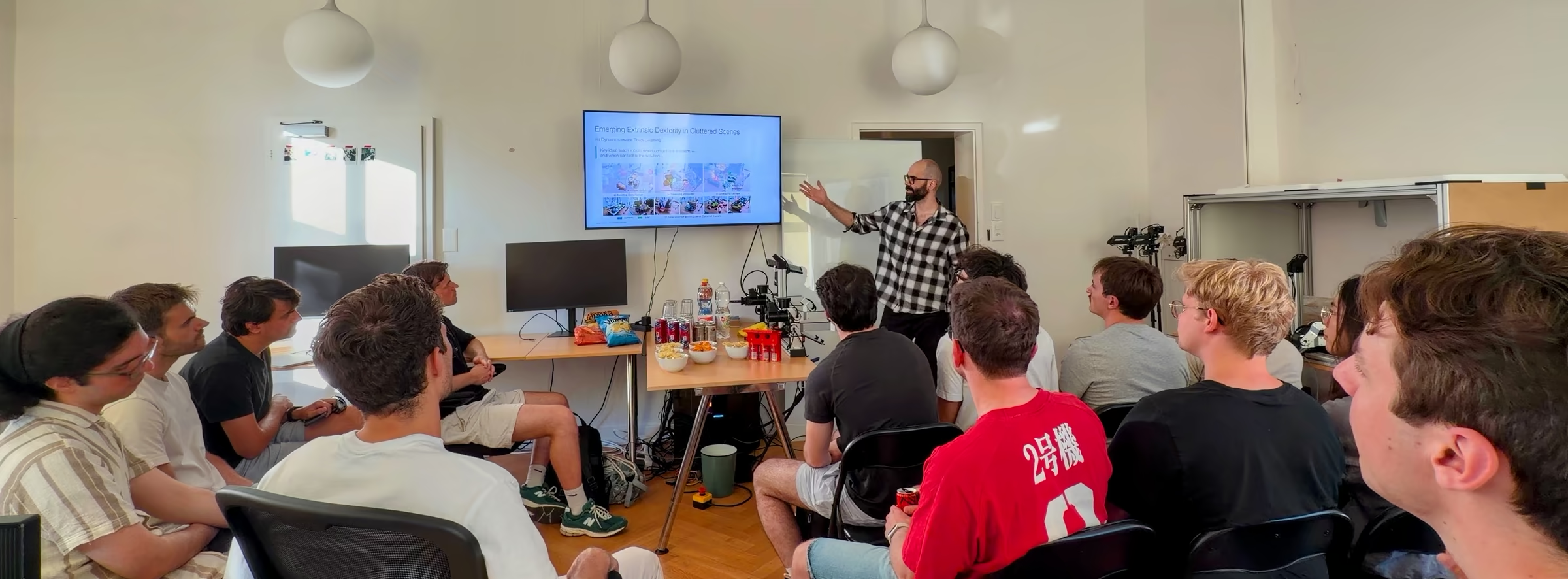
Zurich Robot Learning Paper Club
I participate in Zurich's Robot Learning Paper Club, a community that brings together robotics practitioners, researchers, students, and startup builders. At the July 2026 session, I presented and discussed “Emerging Extrinsic Dexterity in Cluttered Scenes via Dynamics-aware Policy Learning” by Zheng et al., then produced a short video recap of the event.
Contact
I am interested in conversations about robotics platforms, fleet operations, operator tooling, telemetry systems, and simulation infrastructure.